
Apparel enterprises strives to produce in the face of economic recovery
Enterprises expect, with the current vaccination progress, that the epidemic will be controlled from the second half of 2021 to create momentum for economic recovery in major import-export markets of the textile and garment industry. .
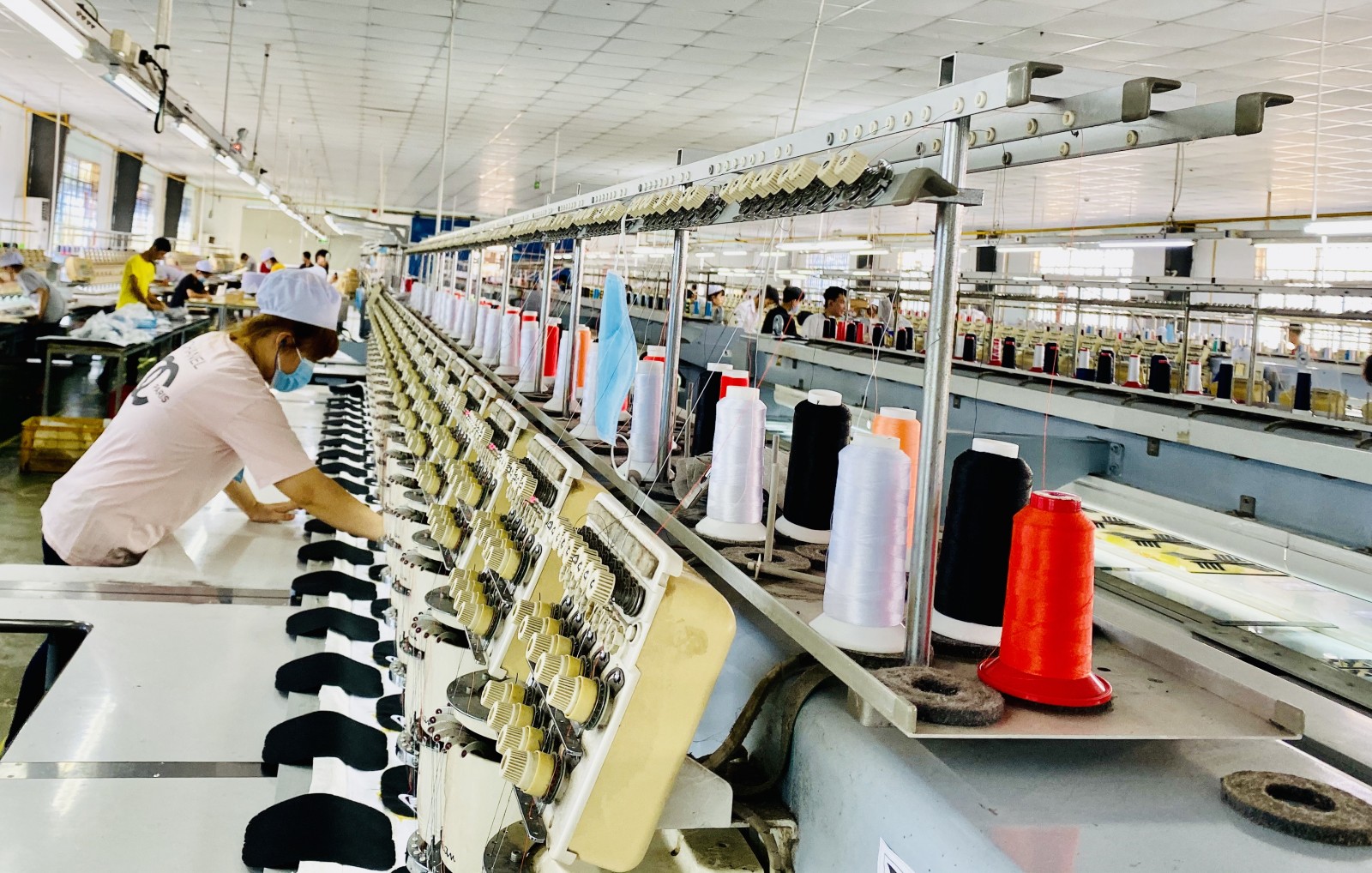
Production activities are on-going at Long Hung Co. Ltd. in Thuan An city
Acceleration of textile industry
Entering the first quarter of 2021, many key industries of Binh Duong were busy with production when the number of new orders has increased. For the textile and garment industry, the number of new orders increased along with signs of improved international market demands - the driving force for businesses to gain their confidence in investing into production.
Typically as the industry uses a lot of labor, textiles are facing competition in recruitment. Enterprises have made efforts to come up with many policies for employees to attract and retain human resources. Nguyen Dinh Thai, Director of responsibility and society of Esprinta Vietnam Co., Ltd. in Song Than 2 Industrial Park of Di An City, said that in order to retain employees, it is necessary to have a regime throughout the illness transitional time not from a short-term raise. Workers also have foresight in choosing a company with a welfare regime that takes care of the well-being of workers.
Nguyen Dinh Thai said that by effective disease control, Vietnam's economy is showing signs of positive recovery. Particularly for Esprinta Vietnam Co. Ltd., purchase orders have flushed back much more than before. Entering the year 2021, enterprises work overtime to organize production and create good conditions for employees to stay with them. The company's labor status from the beginning of the year has been relatively stable.
Grasping the opportunities, many exporting enterprises have invested into expansion of factories. At ViNa DS Company (KSB Industrial Park, Bac Tan Uyen), in early 2021, a new factory was put into operation to welcome such opportunities. “DS ViNa has found a valuable opportunity by taking advantage of the 2021-2025 development strategy for breakthrough. Investing into new and more modern lines is to attract customers' products. In particular, the company pays attention to equipping machines that are the result of the 4th industrial revolution to increase productivity, to reduce costs and to increase product aesthetics,” said the company's leader.
Being aware that the textile and garment industry needs to promote brand building, supplying chains, and supporting industries, Vietnamese businesses also invest into technologies to change management methods and expand connections. Pham Thi Bich Ha, Director of Long Hung Company Limited in Thuan An city, said that the enterprise has just invested into a production line to meet customer needs with the expectation that innovation improves management efficiency in the new situation so as to bring businesses access to the common space of the world fashion industry.
To resolve difficulties
The production and exportation situation of the textile and garment industry has shown many signs of prosperity, but many challenges and difficulties remain and have not been completely resolved. According to Phan Le Diem Trang, Deputy Chairman of Binh Duong Textile and Apparel Association, consumers in the EU and the US are both very strongly reducing their spending. Although the demand for purchasing textiles and garments is still there, prices have been pulled down quite a lot, forcing businesses to recalculate production stages to reduce costs. However, Trang said that for domestic enterprises, even if they have orders, they only meet the level of production maintenance and the prospect is still unclear. Vietnam textile and garment depends greatly on the world while the markets are not yet stable and difficult to grow well.
The year 2021 will be a challenging transitional year when the demand for imports in major markets is still uncertain; the factory is forced to flexibly adjust according to small purchase orders. In that context, products such as suits and high-end shirts will be still facing difficulties while the popular products such as t-shirts and sportswear will have a higher chance. Fortunately, many Vietnamese enterprises have quickly converted to adapt to the needs of the market. That is not to mention, at the beginning of 2021, not only did the shipping costs increase rapidly but many input costs for production also increased rapidly, causing great pressure on enterprises. The trend of decreasing prices and simple goods will replace fashion, leading to the available production capacity to become redundant and a lot of new production capacities appear.
According to industry and trade department, in 2021, many free trade agreements are expected to strongly support Vietnam's textile and garment exports. However, to benefit from these agreements, rules of origin are a major hurdle. The heavy reliance on raw materials imported from China at present makes only a few enterprises able to take advantage of the tariff preferences. Particularly with the Regional Comprehensive Economic Partnership (RCEP), the opportunity is somewhat easier when China joins as a member. Accordingly, textile products using raw materials imported from China and exported to RCEP member countries will enjoy tariff preferences.
Reported by Tieu My – Translated by Vi Bao